Lecture
at
The Say Sí Foundation
“Small Scale Exhibition 2015”
http://saysi.org
Wednesday, March 25, 2015
For: “Seeing Art San Antonio”
A Community for the Promotion of Art and Artists in San Antonio, Texas
http://seeingartsanantonio.com/wordpress/archives/
Since we are standing here in a kind of aesthetic chapel
Surrounded by so many beautiful works of art.
I’m going to give what might seem like a little “sermon” about art .
And I will take as my text
a statement by the great 18thC French painter, Jean-Simeon Chardin,
who said:
“One uses color, but one paints with feeling.”

Perhaps a better translation would be:
“One uses color,
but one paints to summon feeling.”
This statement is a perfect starting point
because it defines the role of Art,
If Science is the tool by which we transmit knowledge.
We can say that Art is the tool by which we transmit emotion.
Although my work is not made with traditional paint and canvas,
it is a painting:
A 21stcentury painting
that obtains its image
by means other than pigment on canvas
When you look at a painting on canvas
You do not really see the image on the canvas.
What you see is the light reflected from the canvas.

In my own work, I use light itself as a ‘pigment’, a medium.
In that sense it is very old.
Categorically, it is “Post-Impressionist”.
In its somewhat analytical approach to light,
the things I make are, perhaps, most akin to the work of Paul Signac

or Georges Seurat

because they (”light boxes") are “paintings” made from wavelengths of light -
which shift and change as you change your point of view:

So - unlike anything else in the room,
this sort of ”painting" is unstable.
What is seen can disappear and reappear.
As does pointillism,
a ”light box” (such as the one below) generates its own color -
colors that I did not put there, but that are ”manufactured” by wavelengths of light interacting with one another in different ways as you change the perspective from which you are looking:

_________________________
A work of art is always an argument -
the artist’s attempt to declare
and to clarify something critical.
Painting (and ”Art" in general)
is an act that almost always arises from some disturbance.
It does not arise from complacency.
The motive is often some sense of a failure,
that something missing,
something that requires evocation –
a summoning of something else that is not present.
Where Reality (the ”world" in all its complexity) fails to attain an ideal resolution,
there the artist strives to resolve in him or her self
the failure of meaning,
strives to provide the missing piece,
strives to fill the void.
This sense of a disturbance,
of a differential that must be resolved
is common to all forms of making art:
whether literature, architecture, poetry, sculpture, music or painting.
The Artist confronts the sensation of Reality
and transforms the “world” by the act of art-making
______________________
If we think of the Neolithic painters – 17,000, even 20,000, years ago
who made their work, by torchlight,
on the walls of caves in Lascaux, France or Altamira, Spain,
we connect with their emotion -

something connective between Art’s very distant past
and its most immediate present.
What is striking about this ancient art is its precision.
There are no mistakes or drips -
This is not expressionism.
This is precise definition
of something summoned,
of something missing.
When you look at these ancient paintings
the sense of disturbance and longing is powerful.
You can almost hear the voices of the artists saying:
“There they are:
wonderful and mysterious,
the animals that we desire,
that we evoke to possess,
that we possess to kill,
and which we paint to bless
deep in the womb of the earth
where Art resolves desire,
and gives birth to dreams of fulfillment.”
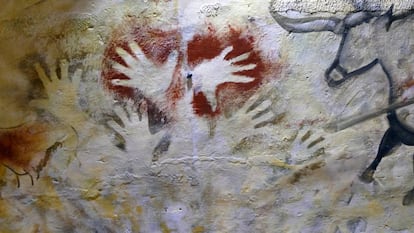
Evocation of this ultimate type,
to which Art aspires,
requires precision:
to make a wish come true,
to make a dream become reality.
_________________________________________
Although some painting looks disorganized - even messy -
think of a painting by de Kooning:

such painting is nevertheless precise.
In the context of the questions presented,
the arguments of these paintings are clear.
Even the messy drips of Pollack are clear
in the evocation of a present
in which something crucial is at stake or missing
Pollacks’ complexity of lines
are a map of, an attempt to give definition to, the complexity of Reality
and of the mysterious complexity of his own ropes of thought and feeling
interacting with all that is "The World”,
and all that is Himself.

Think of the Impressionists [Monet, as below]

and the Post Impressionists [Van Gogh, as below]

who were scorned
when they first exhibited their work.
Yet now, with the hindsight of a hundred years,
it is all so brilliantly clear what they were arguing for:
a simple joy in Life itself
unfettered by centuries of mannerism and hollow courtesies -
empowered by new technologies
that were disintegrating rigid customs
that separated all that was “elite”
from a common Life, a common humanity.
This was the message of Millet (as below), of Pissarro and Van Gogh -

and their Art was the Messenger.
Just as their paintings evoked light
to both define
and to disintegrate form,
my interest in making 3-dimensional ”paintings" (light boxes) employs light in precise, yet unpredictable, ways.

In my practice of art, “precision” is a means
to confront what is missing,
to identify and to clarify what must be summoned to fill a void,
to invoke an ideal reality we know is there
that resolves all issues
that harmonizes the disorganized present
with the perfection of a dream -
a longed for catharsis that confirms that such a reality is present
even if not always visible or perceptible.
I do not think of my work as precise or orderly.
To me it seems to teeter on the edge of chaos -
between the disintegration of meaninglessness
and the ecstasy of belief.
The argument of my practice is this:
that the ideal which is evoked by Art
does, in and of itself, exist.
The ideal resolution only exists because we assert,
and because we insist
that it does.

Because we strive to resolve and achieve it.

That insistent assertion is the delicate, unstable horizon between belief and faith -
an assertion that is both the function and the message of Art -
for which Artists are the Messenger.
Marc F. Wiegand
August 2025


